How LinkedIn Is (Secretly) Driving Powerful LLM Results for Brands

Which online domains do LLM chatbots pull from the most?
Reddit takes the No. 1 spot for citations by ChatGPT, Google AI Mode and Perplexity, a recent study shows. In third place is Wikipedia. Given the breadth of topics and the sheer volume of potential training data available, that’s no surprise.
But here’s where it gets interesting for executives and their companies: LinkedIn is the second-most-cited domain.
This is happening as LLMs chip away at traditional search engines as the go-to source for information. It’s no secret that both B2C and B2B buyers are turning to AI for brand recommendations and comparisons. For companies, GEO (generative engine optimization) is proving just as important as old-fashioned SEO.
And it just so happens that platforms like LinkedIn — filled with real people having real discussions — are a magnet for LLMs and a powerful way for brands to boost GEO rankings.

A three-month study by Semrush found that LinkedIn is the second-most-cited domain by major LLM chatbots.
But there’s a critical twist: it’s personal posts from real people, not posts from company pages, that really move the needle.
For the growing number of leaders who are active on LinkedIn, that’s a huge opportunity. Posts from company leaders’ and executives’ own profiles have an outsized influence in this new paradigm. In the age of AI, here’s how you can turn your personal LinkedIn posts into a secret weapon for strengthening your company’s brand.
Why executive social matters more in an LLM-shaped funnel
LinkedIn is a key part of the public knowledge layer that LLMs — and people using them — lean on to decide whom and what to trust.
When someone asks ChatGPT, “Who makes the best outdoor apparel?”, “Which POS should I pick for my small business?” or “What’s the real story behind this investment firm?”, it searches for the cleanest ways to find reliable information. LinkedIn, with its human conversations and recognizable identities, is a fantastic source for a few key reasons:
It provides credible information that a chatbot can reference
Company websites can be thin on detail about the business, essentially saying, “We’re great.” That may be true, but it’s too vague to show up on an LLM’s radar.
The kind of signal AI engines are actually looking for: a founder, CEO or other executive saying something concrete, in public, with reactions from other users and nuance. Even when the AI doesn’t cite LinkedIn specifically, the presence of a real person — along with a clear stance and specific details — helps shape how it summarizes the brand.
It builds “entity association”
As a leader who represents your brand, you want to make it easy for LLMs to draw positive connections between you, your business, and the products or services it provides. “Entity association” creates those ties so a piece of content can be indexed, understood and retrieved more accurately in search results.
Executive content on LinkedIn is one of the fastest ways to tie:
- A person to a company: “As CEO of Acme Health, my job isn’t to chase trends. It’s to build systems that let clinicians spend more time with patients.”
- A person to a product or service category: “At NorthPeak Capital, everything I do as managing partner comes back to helping founders scale without losing discipline.”
- A company to specific problems solved: “Leading Orion Cybersecurity has reinforced my belief that trust is earned long before a breach — when customers can see their risk shrinking because threats are being detected and contained early.”
- A company to proof points: “Running Atlas Manufacturing has taught me that operational excellence is still the most durable competitive advantage. Our on-time delivery performance proves that.”
That’s exactly what drives who pops up when someone asks an LLM, “What’s the best cybersecurity platform?” or “Who’s a leader in advanced manufacturing?”
It’s a distribution hub for high-authority content
When it comes to LLMs and AI search, LinkedIn adds value beyond just the posts themselves that an executive creates for the platform. In other words, it’s not just what you post but where you point readers to that matters.
The real “cheat code” is using LinkedIn to funnel attention toward the high-authority assets that LLMs prioritize: media interviews and bylines, podcasts and videos (YouTube clips travel well), partner pages, analyst notes and customer success stories. Think of LinkedIn posts as the distribution layer that delivers that content to your audience.
How to leverage LinkedIn to boost LLM recognition and GEO for your brand
Just posting and hoping for the best on LinkedIn isn’t enough. The first and most important step is to ensure that posts are coming from personal profiles — tied to a real identity — rather than company pages on LinkedIn. In that vein, posts from CEOs and business leaders seem to have considerably more weight and impact.

To ensure their content appears in chatbot answers, leaders should build a playbook of posts across several discrete categories. The goal here is to create content that reflects the questions prospects are likely to ask and the answers that bots typically provide.
But there is a caveat: explicitly promotional or salesy content is unlikely to generate much traction. Instead, the key is to share genuine thought leadership and broader commentary on the industry and relevant trends, while also positioning yourself and your company in a favorable light. Here are a few important types of posts to consider.
Category clarity posts
In these posts, define your brand’s space in plain English, with no jargon. For example: “Most companies talk about software in big, abstract terms. We simply build tools that help small business owners spend less time on paperwork and more time serving their customers.”
Comparison posts
Explain how your product or service stacks up against rival offerings. As in: “When we ask customers why they chose us over the competition, it usually comes down to faster deployment, clearer pricing and a product roadmap shaped directly by operator feedback — not slide decks.”
Objection-handling posts
Here, air concerns that buyers might be reluctant to raise. “Something customers don’t always feel comfortable saying out loud is that our product can feel overwhelming at first. It’s on us — not on them — to make it simpler.”
Proof posts
These posts should cover specific outcomes from using your product or service, along with constraints, lessons and trade-offs. So: “Six months after rolling out our platform, one customer cut processing time by 38%, reduced manual errors to near zero, and redeployed their team toward higher-value work.”
Make sure you have a comment strategy, too
Just posting your own updates isn’t enough. Equally important is commenting on other people’s posts. This is critical for several reasons.
First, a thoughtful comment on a peer’s or a customer’s post often travels further than your own post. Their entire network sees it, putting you in front of a relevant audience without having to “broadcast” your own content.
Second, it builds authority by showing that a leader is paying attention to industry conversations, not just promoting their own business.
Third, commenting on others’ posts creates warm entry points to relationships, by opening the door to follow-up conversations with fellow execs, journalists and potential partners in a natural, low-pressure way.
Just posting your own updates isn’t enough. Equally important is commenting on other people’s posts.
How to measure the LLM impact of your LinkedIn efforts
Measuring how people and brands show up on answer engines like ChatGPT and Gemini is still an evolving discipline. However, there are some simple ways to see if your LinkedIn efforts are paying off.
One approach is create a small “prompt bank” and run it monthly across several LLMs. Let’s say you lead Autonomiq, a SaaS company specializing in enterprise workflow automation. Here are a few possible prompts:
- “Best workflow automation platform for enterprises”
- “Alternatives to Autonomiq”
- “Is an Autonomiq subscription worth the money?”
Each time, track who shows up, what gets cited and how your company is described. While this isn’t an exact science, if you see your rankings rise in tandem with the quality and volume of your LinkedIn efforts, you can infer a positive correlation.
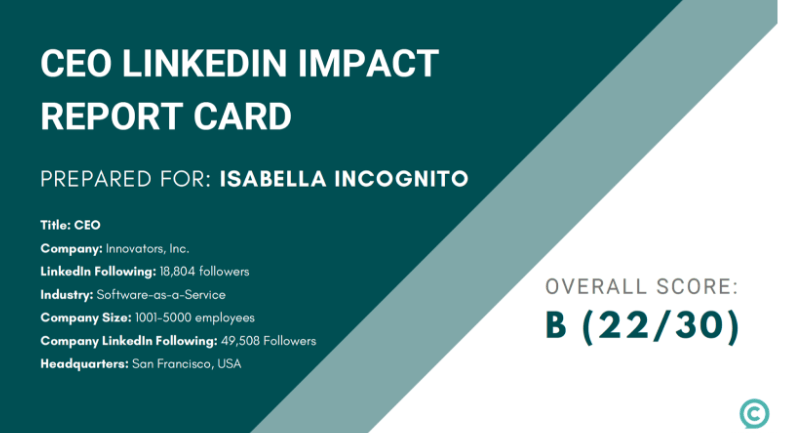
Curious How Your Company's CEO is Doing on LinkedIn?
We specialize in helping executives put their best foot forward. If you're curious how your company's CEO is doing on LinkedIn, share a link to their profile, and we'll prepare a customized CEO LinkedIn Impact Report Card like this.