Corporate Reputation Management Vs. Personal Brand Management

TL;DR Corporate reputation management protects how a company is perceived, while personal brand management does the same for the individual leading it.
- This piece traces how the two differ, then explains why they increasingly overlap as CEOs and other senior leaders become the face of the companies they run.
- From there, it covers when the two need to be managed separately, and closes with practical guidance on how executives can build a personal brand that holds up on its own.
When Tim Cook was named CEO of Apple in 2011, many wondered if he could fill co-founder Steve Jobs’ shoes. Fifteen years later, as Cook steps down from the top job, there’s another question worth asking. How much of Apple’s reputation rests on the person running it?
Cook leaves Apple with a personal reputation built around qualities now closely associated with the tech giant: operational excellence, a steady hand, and a measured public presence. But Apple’s reputation is bigger than its CEO. Products, employees, policies, customers, and business decisions all play a role in shaping it.
That distinction is important for every company with a high-profile executive. Corporate reputation and personal brand overlap, but they aren’t the same thing. An executive’s reputation can reflect well on a company, just as the business can influence how an executive is perceived. But managing the two requires different approaches.
What makes corporate reputation especially fragile is how little control any one person has over it.
What Is Corporate Reputation Management?
Corporate reputation management is the effort to shape how a company is perceived by the people with a stake in it. This reputation has several measurable parts, from product quality and workplace culture to how transparently a company is governed.
That breadth makes reputation difficult for any single communications team to control. Comms can shape the messaging, but the material they’re working with gets set upstream, in decisions the C-suite, HR, and legal make long before a press release goes out.
A strong reputation compounds over time. It buys a company patience from stakeholders: room to make a mistake, plus the benefit of the doubt when there’s a reasonable explanation. A damaged reputation quickly has the opposite effect, and the fallout tends to linger.
What makes corporate reputation especially fragile is how little control any one person has over it. A lawsuit or a leaked internal memo can undo years of accumulated trust in a single news cycle, with the damage hitting the whole organization rather than one executive. That’s why reputation management increasingly means watching for trouble before it starts rather than responding when it arrives.
What Is Personal Brand Management?
Personal brand management is the effort to shape how an individual is perceived. Harvard Business Review describes it less as self-promotion than the impression that forms once people have seen what someone can do and what they actually value.
For an executive, that reputation is often built around expertise, judgment, and a clear point of view. That’s where executive thought leadership comes in — the art of curating and sharing your unique expertise and insights as a leader. The executive builds an audience by sharing those insights on different channels, whether it’s a bylined op-ed, a LinkedIn post, or a conference stage.
Building that executive visibility takes more than posting social updates. Someone has to figure out which topics truly belong to the leader, then turn their thinking into writing that still sounds like them once it’s published or delivered in a speech.
Getting that writing in front of the right audience is its own skill, from pitching an editor to keeping a following engaged. Few executives have a standing relationship with editors, but a thought leadership agency can help there, too.

Nvidia founder Jensen Huang’s personal brand has become synonymous with how people talk about the chipmaker.
Corporate Reputation Management Vs. Personal Brand Management: What’s The Main Difference?
Corporate reputation management has traditionally been reserved for companies, and personal branding for individuals. “Personal brand” used to belong to celebrities, politicians, and other public figures, not to people running businesses. A CEO’s job was to lead the company. With rare exceptions, whether any knew their name was beside the point.
That’s changed. Individuals — CEOs, VPs, and other senior leaders — are increasingly the face of their companies. Managing their personal brand has become a key piece of overall corporate reputation management, but that doesn’t mean the two should be treated as the same exercise.
Corporate reputation is fundamentally institutional: it’s about what stakeholders believe about the organization. Personal brand is fundamentally individual: it’s about what people believe a particular leader knows, values, and stands for.
Nvidia is the chipmaker that became essential infrastructure for the entire AI industry. Founder Jensen Huang’s personal brand, leather jacket included, has become almost inseparable from how people talk about Nvidia’s rise. The two aren’t identical, but they clearly overlap, and that intersection is creating real value for the company.
How Does An Executive’s Personal Brand Affect Corporate Reputation?
Increasingly, stakeholders see the CEO and the company they lead as connected signals. When a leader speaks with authority and consistency, that credibility can extend to the business they run.
Executives get this. Eight out of 10 believe that for a company to be highly regarded, it’s important for the CEO to have a visible public profile. Executives also estimate that about half of their company’s market value is attributable to the CEO’s reputation.

Consumers feel the same way. About 85% think a CEO’s reputation now matters as much as the brand they lead, while roughly the same share say a CEO can damage a brand faster than ever.
For executives, this underscores the importance of having a robust personal brand. Building that kind of visibility takes work: a steady LinkedIn presence, a newsletter or blog in the executive’s own voice. Bylined articles and appearances in media extend that reach into outlets the company doesn’t own. For many executives, covering all those bases requires dedicated outside support to shape the message, maintain consistency, and open the right doors.
How does corporate reputation affect an executive’s personal brand?
The relationship runs the other way, too. An executive’s brand can gain a boost, or take a bruise, based on their company’s reputation. For example, working for a brand as well-known and respected as Google is a badge of accomplishment any executive carries throughout their career.
On the other hand, Boeing’s 737 MAX crisis cost CEO Dennis Muilenburg his job in 2019, even though he wasn’t personally responsible for designing the aircraft or making every decision that led to its failures. As CEO, however, he ultimately bore responsibility for the company’s decisions.
Muilenburg’s ouster shows how fast an executive’s credibility can erode when the company they run stumbles. A leader with an established thought leadership platform enters a crisis with more credit in reserve than one who’s starting from scratch and is often able to better weather the storm and thrive in a new role.
Corporate communication is built to stay consistent and safe. An executive’s voice works better with some rough edges, closer to how that person actually talks and thinks.
When Do The Two Need To Be Managed Separately?
There’s a real risk in treating an executive’s brand as just another extension of the corporate one. Part of what makes a leader memorable is what makes them different from the company they run: their voice, whether it’s in a written message or on an event stage. Flatten that into corporate messaging, and an executive risks erasing what makes them special.
Corporate communication is built to stay consistent and safe. An executive’s voice works better with some rough edges, closer to how that person actually talks and thinks. The goal is to make them sound recognizably like themselves. Protecting that distinction, rather than smoothing it into the company’s tone, is easier with help from a thought leadership expert who focuses on the individual rather than the institution.
There’s a practical reason to keep corporate reputation management and personal brand management separate, too. Executives change companies over the course of a career, and a personal brand shouldn’t expire the moment they leave for a new role.
Meg Whitman spent a decade as CEO of eBay, then carried her reputation as a decisive, hands-on operator into Hewlett-Packard, even though the hardware giant had little in common with an online marketplace. Whitman might have changed companies, but what people expected from her as a leader didn’t.
How should executives approach managing both?
Executives should treat personal brand as its own discipline, with its own strategy and voice, rather than folding it into whatever the corporate communications team has running. The two should stay in sync without becoming identical.
Corporate communications manages the institution. Thought leadership helps build the person. The most effective executive communications strategy understands how the two can reinforce each other without blurring.
In practice, that usually means dedicated support. Most executives don’t have the bandwidth to build a distinctive voice alongside running a company. They need someone who studies how they talk and think, then works with them to keep that voice consistent over time.
Making Executive Reputation An Asset
For executives looking to strengthen their company’s reputation, a strong personal brand can be a powerful asset. The right thought leadership partner can help turn an executive’s expertise and perspective into a distinctive voice that supports both their reputation and the business. To learn more about building your personal brand, read this.
FAQ
What is the difference between brand management and reputation management?
Brand management shapes what a company chooses to say about itself: its name, its positioning, the promise behind the product. Reputation management deals with what happens once that promise meets reality. A brand can be controlled from the top down. A reputation gets built by everyone the company touches, whether or not the company is paying attention.
What is the difference between personal branding and reputation?
Personal branding is the story someone chooses to tell about their own skills and expertise. Reputation is what people actually conclude after watching that person operate over time. The brand is something you can shape directly. The reputation belongs to everyone who’s dealt with you, and it can drift away from the brand if the two stop lining up.
What is the difference between brand and corporate reputation?
A brand is usually the customer-facing piece: the name, the positioning, the experience someone has with the product. Corporate reputation is bigger. It’s how the company is perceived by everyone connected to it, well beyond the people who buy from it. A company can have a strong product brand and still carry a damaged corporate reputation if the trouble is somewhere else, like how it treats employees or how its leadership is run.
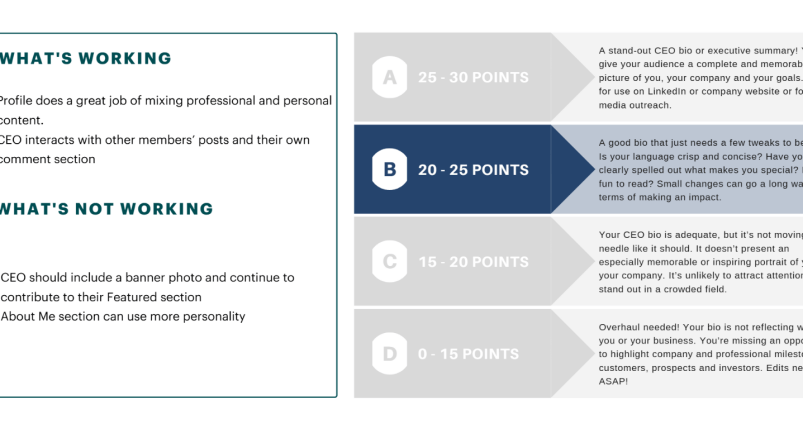
Curious If Your CEO or Executive Bio is Having the Right Impact?
We specialize in helping CEOs and senior executives put their best foot forward. If you're curious whether your bio is working for you, share a link to your profile on LinkedIn or your bio on your company website, and we'll prepare a customized Executive Bio Report Card like this.