Social Media for Public Relations: A Strategic Guide

TL; DR Social media is now central to PR. Brands and leaders can use it build reputation by going direct to customers, journalists, investors, and other stakeholders. Strong strategies integrate social into the broader PR plan, with LinkedIn playing a key role in executive thought leadership. Liquid Death, Blackstone, Duolingo, and Stanley show that speed, personality, and audience participation often outperform polished campaigns or traditional media outreach.
When Mike Cessario launched Liquid Death in 2019 — canned water with heavy metal branding and a “Murder Your Thirst” tagline — most people thought it was a joke. Today it’s a $1.4 billion brand, built almost entirely on social media’s appetite for the unexpected.
Cessario bet that if you designed a product people actually wanted to be seen with, the marketing would take care of itself. Position the brand as an entertainment company first, and let the PR follow. It worked. Liquid Death’s cans now generate hundreds of thousands of unprompted customer posts, because cracking one open has become a statement.
That kind of visibility now sits at the center of modern public relations. Social media gives brands a direct way to build credibility, shape reputation, and stay part of the conversations that influence customers, journalists, investors, employees, and peers.
For companies and executives, the key is to understand how quickly those conversations can shape public perception. The brands that use social well make it a core reputational asset, with a clear voice, a responsive presence, and a role in the broader PR strategy.
To understand what that shift means in practice — and how to make it work for you — here’s what you need to know.
The brands that thrive are the ones that approach social media as an ongoing relationship rather than a broadcast platform.
What Role Should Social Media Play In A PR Plan?
Social media public relations is now a core part of modern PR strategy: the place where brands build visibility, respond to stakeholders, amplify earned media, and shape reputation in real time.
The strongest brands use social as a relationship-building tool, staying close to the conversations, questions, and criticisms that influence public perception.
Where PR once meant managing relationships with a relatively small number of journalists and editors, it now means navigating an always-on conversation involving customers, critics, and algorithms. The brands that thrive are the ones that approach social media as an ongoing relationship rather than a broadcast platform. After all, social is now the top source for breaking news, ahead of TV, podcasts, news apps, and print ads.
Executives who are active and credible on social media extend that relationship even more. By building personal authority that reflects well on the brand, they signal a confidence that corporate accounts alone can’t project.
About nine out of 10 professionals are more likely to trust a company whose senior executives are active on social media, making that visibility one of the most valuable assets in a PR team’s toolkit.
How has social media changed PR?
The most significant shift is speed and directness. Brands and leaders no longer depend on journalists to carry their message. Instead, they can post in minutes and personally engage with anyone who responds. But going direct raises the stakes, too. Audiences expect transparency, and they notice when it’s absent.
Why is social media now central to PR strategy?
Today, social media is where trust is built or broken. A brand’s social presence is often the first place a journalist, investor, or potential customer goes to take its temperature. It signals values, personality, and responsiveness in a way that a website or a media placement simply can’t.
Brands that treat social as a soapbox for announcements miss this entirely. The ones that get it right use social to demonstrate who they are, consistently, over time.
What are the benefits of social media PR?
The obvious benefit is reach: the ability to access huge audiences at relatively low cost. But the more durable benefit is relationships. Social media creates a feedback loop that traditional PR never could: you can see what resonates, hear from your audience directly, and adjust in real-time. Done well, it turns customers into advocates and gives a brand the kind of credibility that paid media can support but never fully replace.
How Do You Integrate Social Media Into An Existing PR Strategy?
When adding social media to a PR plan, the first impulse might be to treat it as a separate workstream. Comms handles media relations, social handles posting, and the two occasionally exchange assets.
That division made sense once, but it doesn’t anymore. Today the journalist covering your industry is sourcing stories on LinkedIn, the investor forming an opinion of your CEO is doing it via their last 10 posts, and a crisis can go from a single tweet to a national story before a response meeting has been scheduled. Social and PR must be planned together, with shared goals and metrics.
In practice, that means:
Aligning calendars
Social content should map to the same editorial calendar as your PR activity, so both teams amplify the same narrative at once.
Briefing executives early
If a story is breaking or an announcement is landing, leadership should be ready to post or respond the same day, not a week later when the moment has passed.
Building a rapid-response protocol
Every PR plan should define how social channels are managed during a crisis: who approves posts, how fast, and in what tone. Discovering mid-crisis that you don’t have a plan is too late.
Treating social listening as intel
Monitoring what journalists, competitors, and audiences are saying in real-time is a PR function, and it should feed directly into communications strategy.
Applying editorial discipline to owned channels
A brand’s LinkedIn or Instagram should be run with the same rigor as any other communications channel. That means having a consistent voice, planned content, and a clear point of view.
Which social platforms matter most for PR?
Not all platforms are created equal for PR purposes, and spreading yourself thin across all of them is a recipe for mediocrity. The smarter approach is knowing where your audiences — journalists, investors, customers, and peers — actually spend their time. For most brands, the answer is two platforms done well, not five done poorly.
LinkedIn is often the right place to start. At almost 60%, it’s journalists’ most trusted social network, and its broader audience of business professionals, senior decision-makers, and investors makes it the natural home for executive thought leadership and corporate reputation-building alike.
X retains value for brands in tech, finance, and public affairs, where its core audience of journalists and professionals remains active. But its broader influence has diminished considerably, and few PR teams should treat it as a primary channel anymore.
Instagram and TikTok matter most for consumer-facing brands, where public perception is shaped less by media relations than by the content audiences create and share about you.
An executive who posts regularly — sharing perspectives or acknowledging challenges — builds credibility over time.
How should executives use social media as part of PR?
For leaders, having a strong social media presence is now a foundational part of a social PR strategy. Stakeholders want to connect with real people on social media, and company leadership are ideal for leading that conversation. And the ROI is real: on LinkedIn, for example, CEO posts generate 7 times more impressions and 4 times more engagement than brand-led content.
The most effective approach for leaders is consistency. An executive who posts regularly — sharing perspectives or acknowledging challenges — builds credibility over time. That pays dividends when it matters most: a crisis, a product launch, or a difficult quarter. PR teams should own executive social as part of their broader role, helping leadership find a real voice and stay visible on the right platforms.
The strongest executive social content usually comes from a leader’s real operating context: what they are seeing in the market, what they are learning from customers, how they make decisions, and where they believe the industry is headed.
What Are Examples Of Successful Social Media PR Campaigns?
The most effective social media PR campaigns tend to look less like announcements and more like moments people want to participate in, remix, or talk about. Here are three more that clicked.
Blackstone: The Financier Who Jogged His Way To LinkedIn Fame
The setup: Blackstone president and COO Jon Gray helps oversee roughly $1 trillion in assets — at first glance, not the promising raw material for a viral social media presence. But since Gray began experimenting with LinkedIn video last year, he’s become one of the most-watched executive voices in finance.
The campaign: Gray describes himself as an “accidental influencer.” After pushing back on the suggestion that he try video, he finally took the plunge on a business trip to Sydney: a quick, selfie-mode running clip outside the Opera House. The comments section exploded with running tips and local recommendations. Gray was hooked.
The execution: Gray turned his packed travel schedule into an informal content engine, filming short jogging dispatches from cities around the world with nothing but his phone. No script, no coaching, no prep calls — just a sweaty exec talking candidly about everything from superintelligence to patient investing to economic trends.
The numbers: Gray’s videos regularly yield some 440,000 impressions and average over 100,000 views apiece. A single travel montage from Europe got 5.9 million views. His January snow-jogging clip in Central Park hit 2.7 million. The production budget? Essentially zero.
The lesson: Blackstone found that polished studio content routinely underperformed Gray’s spontaneous clips. For executive social media, showing up real beats showing up perfect.
Dua Lipa reacts to the death of The Duolingo Owl:
“Til’ death duo part 💔” pic.twitter.com/Nnvo7zlc6o
— Pop Base (@PopBase) February 12, 2025
Duolingo: The Brand That ‘Killed’ Its Own Mascot
The setup: Duolingo spent years turning Duo the Owl from a simple app logo into a full-blown social media character, complete with a grudge against users who skipped their language lessons and a fictional obsession with Dua Lipa.
The campaign: Three days after the 2025 Super Bowl — when cultural attention was still at peak pitch — Duolingo announced across all its social channels that Duo had been killed by a Cybertruck. The company pinned the blame on its own customers: people who had been letting Duo down by neglecting their practice.
The execution: Leading up to the revelation that Duo had actually faked his own death, Duolingo ran a two-week campaign across TikTok, X, and Instagram, challenging users to earn a combined 50 billion XP (experience points) to bring the mascot back.
The numbers: The campaign generated 1.7 billion organic impressions, twice the social chatter of the top Super Bowl ads that year. The death announcement alone hit 144 million views on X. Dua Lipa’s organic reshare added 667,000 engagement actions. iOS downloads peaked at their highest single-day total of 2025, and Q1 revenue rose almost 40% year-over-year.
The lesson: The campaign worked because Duolingo had spent years making people genuinely care about a cartoon owl. Viral buzz tied directly to product engagement — the XP challenge drove real lesson completions — not just attention.
@stanley1913 #stitch with @Danielle ♬ original sound – Stanley 1913
Stanley: The President Who Bought A Stranger A Car
The setup: Stanley had already been on a remarkable growth run, turning the century-old thermos brand into a cultural phenomenon largely via influencer marketing and TikTok.
The campaign: In November 2023, a customer posted a TikTok of her fire-destroyed car — with her Stanley tumbler sitting intact, ice still unmelted inside.
The execution: Rather than issue a statement, Stanley president Terence Reilly dropped his own TikTok response within 24 hours. Reilly offered the customer replacement tumblers — and, in a move nobody saw coming, a brand-new vehicle.
The numbers: Stanley’s social impressions and engagement jumped more than 600% that November. Over the next couple of months, the original video generated almost 100 million views and 9 million likes, while Reilly’s response drew almost 54 million views and close to 7 million likes.
The lesson: Speed matters. So does putting a real executive on camera instead of hiding behind a press release. That unexpected gesture turned a viral accident into a brand-defining moment.
Curious About Building Executive Authority On Social?
A strong executive social strategy starts with a clear point of view and a consistent approach to thought leadership. The right agency can help leaders turn their expertise into social media content that builds authority, earns trust, and supports broader PR goals. To learn more, read this.
FAQ
What is social media public relations?
Social media PR is the use of social platforms to build, manage, and protect a brand’s public reputation through direct communication with customers, journalists, investors, and other stakeholders.
Is PR going to be replaced by AI?
The broad consensus is no, but the role is changing. AI can help with monitoring, reporting, drafting, and social listening, but it can’t replace the judgment, relationships, and real-time decision-making that effective PR requires.
How do you measure social media PR?
Social media PR can be measured through reach, engagement, sentiment, share of voice, journalist interactions, executive visibility, referral traffic, and the quality of conversations generated. The most important metrics depend on the goal: reputation-building, crisis response, media amplification, or audience trust.
What skills are needed for social PR?
The core skills needed for social PR are writing, strategic thinking, and an instinct for what resonates with a given audience on a given platform. Beyond those fundamentals, effective social PR practitioners should also be comfortable with data and, increasingly, with the AI-powered tools that are becoming standard across the industry.
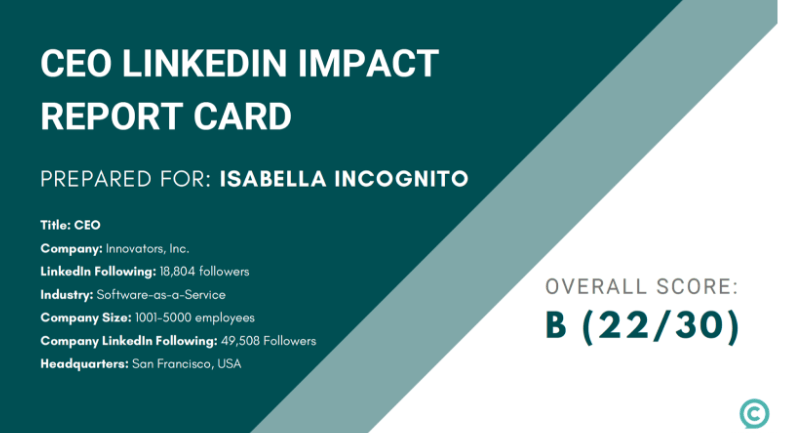
Curious How Your Company's CEO is Doing on LinkedIn?
We specialize in helping executives put their best foot forward. If you're curious how your company's CEO is doing on LinkedIn, share a link to their profile, and we'll prepare a customized CEO LinkedIn Impact Report Card like this.