Top 9 Business Thought Leaders to Follow in 2026

No matter how effective you are as a business leader, there’s always room to grow.
Keep reading to learn about some of the most influential business thought leaders to follow in 2026, along with how you can get started on your thought leadership journey and wind up on lists like this in the years to come.
Top thought leaders to follow in 2026

1. Alexandr Wang, founder and CEO, Scale AI
Interested in keeping current with the rapid pace of innovation in AI? Follow Alexandr Wang, founder and CEO of Scale, the data platform for artificial intelligence, which he’s been building for the last decade.
Last year, Wang made headlines for broadcasting his company’s hiring policy, which he calls MEI: merit, excellence, and intelligence. Though the post proved controversial, Scale secured a $14.3 billion investment from Meta — more than the company’s then-$13.8 billion valuation.

2. Lex Fridman, podcast host
Though perhaps not a traditional thought leader per se, Lex Fridman hosts a podcast that features leading thinkers in all sorts of fields, including AI, philosophy, and government. Recent guests include Telegram founder Pavel Durov, Google CEO Sindar Pinchai, and Narenda Modi, prime minister of India.
Fridman invites guests for longform discussions that typically last two to four hours; Elon Musk sat down for more than eight. If you’re interested in keeping up with what some of the world’s most influential people are thinking and working on, he’s worth a follow.
3. Anne-Laure Le Cunff, PhD, neuroscientist and founder of Ness Labs
Interested in figuring out how to think, learn, and work more effectively in 2026? Give neuroscientist, founder, and author Anne-Laure Le Cunff a follow.
Le Cunff’s LinkedIn profile is filled with content that explains how reading helps you think clearer, why it’s better to experiment instead of chasing linear goals, and how to feel joy in small moments, among other actionable advice.

4. Ethan Mollick, professor at The Wharton School and author
Ethan Mollick is a professor at Wharton, where he’s also the co-director of the school’s Generative AI Lab. Mollick studies innovation, artificial intelligence, and entrepreneurship and regularly shares insights into how emerging technologies are reshaping work and how business leaders can use AI to supercharge their businesses.
If you want to stay on top of what’s latest at the intersection of business and technology, Mollick should be on your radar.

5. Gina Mastantuono, president and CFO, ServiceNow
As president and CFO of ServiceNow, Gina Mastantuono regularly shares thought leadership insights on LinkedIn about technology, AI, and the critical role human experience continues to play in successful businesses. She’s also very vocal about what it takes to be an effective leader.
Recently, Mastantuono shared some straightforward advice: “Hire people who can do your job.”
With a career spanning more than three decades, including stops at Ernst and Young and Revlon, and board seats at Roblox and Gong, Mastantuono’s experience gives her a broad perspective on leadership and effective business strategy that’s definitely worth exploring.

6. Tobi Lütke, co-founder and CEO, Shopify
As CEO of Shopify, Tobi Lütke knows what it takes to succeed in business. In April 2025, he kind of “broke the internet” when news came out that he told his employees to prove that AI couldn’t do jobs before asking to hire new team members. Founded 20 years ago, Shopify has grown into an ecommerce juggernaut with a market cap in excess of $215 billion.
Interested in bringing your business on a similar trajectory? Keep tabs on what Lütke has to say about entrepreneurship and leadership.

7. Julie Sweet, chair and CEO, Accenture
After working at a law firm for more than 17 years, Julie Sweet joined Accenture in 2010 as general counsel and chief compliance officer. Nine years later, she was promoted as the global consulting firm’s CEO.
In this capacity, Sweet has become a powerful voice on digital transformation and effective leadership. Follow her on LinkedIn for insights on how businesses are leveraging technology to become more productive and what leaders can do to inspire their teams to reach their full potential.

8. Jyoti Bansal, CEO and co-founder, Harness
Jyoti Bansal is a serial entrepreneur who’s built multiple unicorns over the last two decades. In 2017, Bansal’s first startup, AppDynamics, was acquired by Cisco for $3.7 billion; his newer venture, Harness, recently raised $240 million at a $5.5 billion valuation.
If you hope to scale a business into a big-ticket exit, it’s worth following Bansal, who regularly shares insights into artificial intelligence, the DevOps industry, and strategies founders can use to accelerate growth.

9. Dax Dasilva, founder and CEO, Lightspeed Commerce
Founder of Lightspeed Commerce, Dax Dasilva has been building his company from the ground up for more than 20 years.
Curious to learn about cutting-edge retail and restaurant technology … or maybe some of the factors that influence high-stakes decision-making in the C-suite? Dasilva’s LinkedIn is filled with actionable entrepreneurial insights to both effects.
Beyond that, he regularly shares advice on how leaders can stay at the top of their game and what they can do to build more impactful, customer-centric businesses.
How to become a thought leader
There’s a reason these business leaders and people like them are prioritizing strategic thought leadership.
By investing in thought leadership, executives can:
- Drive industry conversations
- Increase brand awareness
- Generate new business opportunities
- Differentiate their businesses from competitors
Little wonder research from The Harris Poll found that investments in thought leadership generate 14x ROI.
Interested in developing your own thought leadership footprint? Follow these four steps to begin your journey.
1. Choose your lane and audience
What unique insights do you have to share with the world? What does your ideal audience look like, and what do you want them to know?
Kick things off by identifying the topics you want to talk about and the specific problems you want to be an authority on. Once you’ve figured that out, learn as much about your target audience as you can and find out where they spend their time.
Using these insights, you can create a detailed thought leadership strategy that engages the right people.
A word to the wise: If you try to speak to everyone, don’t be surprised when no one listens.
2. Build your platform through consistent posting
Where should you share your thought leadership? Most business leaders should be on LinkedIn because that’s where executives hang out. In addition to LinkedIn, a good thought leadership strategy includes a mix of distribution channels, including blogs, bylines, podcasts, and social platforms like Instagram and X.
After identifying the channels you’ll use, share a blend of insights, opinions, and practical advice on a regular cadence. A steady stream of content makes it easier to stay top of mind with your audience, so don’t let perfect be the enemy of good.
Pro tip: If you need help with content creation, you can always link up with a thought leadership agency.
In thought leadership, consistency really moves the needle: One report found that CEOs who start posting more frequently on LinkedIn see a 39% increase in followers on average.
3. Engage with your community
As you begin publishing thought leadership content regularly, it’s only a matter of time before your audience starts weighing in on what you have to say. When the comments come in, respond thoughtfully. Acknowledge, ask questions, and try to encourage conversation.
At the same time, take time to participate in larger industry conversations. Thought leadership isn’t just about you. It’s about what you’re doing to bring the industry forward, and how you’re helping your peers and the next generation improve.
Transcending the digital world and engaging IRL is equally important. Industry conferences and events, professional meetups, and of course media interviews and podcasts can all help grow your thought leadership footprint.
4. Measure your impact and iterate
The best thought leadership strategies are fueled by data. By tracking key metrics — engagement, reach, and follower growth — you can identify which topics and content formats make the biggest impact.
While statistics are great, qualitative feedback (think comments and direct messages) is equally important. If no one ever comments on your posts and then suddenly eight people chime in, you may be on to something.
By measuring the impact of your efforts, you can see what’s working best and try to replicate that magic.
The right thought leadership strategy can accelerate your business. But building one takes time, expertise, and commitment.
When you’re ready to take the next step in your thought leadership journey, reaching out for support can accelerate your growth.
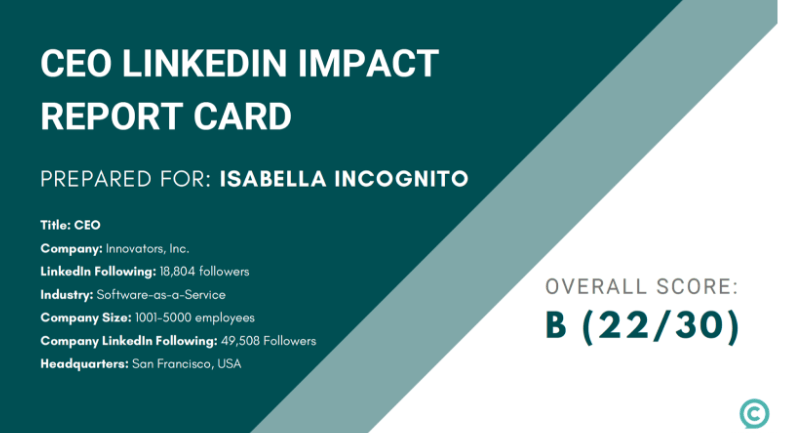
Curious How Your Company's CEO is Doing on LinkedIn?
We specialize in helping executives put their best foot forward. If you're curious how your company's CEO is doing on LinkedIn, share a link to their profile, and we'll prepare a customized CEO LinkedIn Impact Report Card like this.