What Is Corporate Affairs? Definition and Key Functions

TL;DR Corporate affairs manages a company’s relationships with regulators, investors, media, and the public.
- This piece traces how the function differs from PR and corporate communications, then explains why the role is expanding, pointing to regulatory complexity, political instability, and rising scrutiny as the forces pushing corporate affairs into strategy and closer to the CEO.
- From there, it covers the skills that separate strong professionals from generalists and the challenges teams face today. It ends with three practical steps for building an effective corporate affairs function.
Mark Zuckerberg didn’t hand Meta’s relationship with world governments to a communications veteran. He gave it to an ex–Marine artillery officer who once ran policy out of George W. Bush’s White House.
In early 2025, Meta promoted Joel Kaplan to chief global affairs officer, replacing former UK deputy PM Nick Clegg, whose 2018 appointment had itself marked a new era for corporate policy roles in Silicon Valley.
The title of chief corporate affairs officer varies by company, but the role has outgrown its old mandate. Corporate affairs teams used to write press releases and field reporters’ calls. Now they draft regulatory strategy, sit close to the CEO, and help shape how the business responds to a changing landscape.
What Is Corporate Affairs?
Corporate affairs manages everything that happens when a company meets the outside world: regulators, lawmakers, investors, media, and the public. It operates at the intersection of policy, communications, and corporate strategy, turning external developments into decisions made inside the business.
What does a corporate affairs team do?
A corporate affairs team runs government relations and regulatory strategy, and manages the company’s reputation with the media and the public. It coordinates with investor relations on how the business explains itself to shareholders, while also often playing a central role in crisis response when things go sideways.
The tricky part is keeping the story straight across all of those audiences at once, so a message that works with regulators doesn’t contradict what the CEO tells investors or what customers read in the news.
Why Is The Corporate Affairs Role Expanding?
Three forces are pushing corporate affairs beyond communications and into the strategy realm:
- Regulatory complexity is growing. A company operating across borders now answers to competing privacy laws, antitrust regimes, and AI rules that vary by jurisdiction and change constantly. A misstep can mean not just bad press but loss of market access, too.
- Political instability now moves markets and supply chains. Trade wars, sanctions, and shifting alliances can upend a business overnight. Boards want that exposure identified, modeled, and managed with the same rigor as financial risk, rather than bolted on after the fact.
- Scrutiny has widened, too. Employees, investors, and customers now expect companies to take positions on issues that once sat outside the business. Staying silent can backfire, with consequences for a company’s reputation and financial health.
Corporate affairs is too big a job for communications alone. It calls for people who can read a regulatory filing and negotiate with a government. They need to understand geopolitical risk, and earn a seat in the room where the company decides its next move.

Who Is Responsible For Corporate Affairs Within An Organization?
Most companies put one executive in charge: a chief corporate affairs officer, a president of global affairs, or a head of government relations, depending on the business. That person typically leads several smaller teams: government relations, media relations, investor communications, and crisis management. These are often managed as one coordinated function instead of separate departments each competing for the CEO’s attention.
Where that executive sits on the org chart says a lot about how seriously the company treats the job. At some businesses, corporate affairs reports to the CEO via the general counsel or chief communications officer, one step removed from the top.
At others — especially in industries facing heavy regulation or constant public scrutiny, like finance, healthcare, and technology — the role often deals directly with boards and executive committees.
How does corporate affairs differ from public relations and corporate communications?
Public relations focuses heavily on managing a company’s relationships with external audiences, including the media, while corporate communications is broader. It covers employee messaging, executive visibility, and how the company tells its story across every channel, not just the press. That includes helping senior leaders develop a clear and consistent voice on the issues that matter to the business.
Corporate affairs is broader still, bringing communications together with government relations, policy analysis, investor coordination, and community engagement. Corporate communications asks, “How should we say this?” Corporate affairs asks, “What should we do?” Corporate affairs helps inform that decision, then brings communications into the process.
The risks that corporate affairs manages might once have been background noise, but they’ve become boardroom material.
Why is the chief corporate affairs officer gaining direct access to the CEO?
The risks that corporate affairs manages might once have been background noise, but they’ve become boardroom material. Boards now treat reputation as a financial variable rather than a communications one, given that public backlash can move a company’s valuation as swiftly as an earnings miss.
Lately, Meta’s Chief Global Affairs Officer Joel Kaplan has been managing a Federal Trade Commission appeal of a ruling that let the tech giant keep WhatsApp and Instagram, plus an EU investigation into whether its AI policy is shutting rival chatbots out of WhatsApp. On top of that, Meta has to stay aligned with the current US administration.
These aren’t problems that can wait for a memo to travel up through legal or communications first. They require senior leaders to have timely information and a direct role in the response.
BHP Billiton was a trailblazer back in 2013, giving its corporate affairs leader a seat on the executive committee and direct access to the CEO. Many other companies have followed suit.
Today, when a single regulatory ruling or public controversy can undo years of strategy in one news cycle, whoever’s tracking that risk needs a direct line to senior decision-makers. If corporate affairs reports several layers down, a company can miss getting ahead of an issue.

What Skills Do Corporate Affairs Teams Need?
The modern corporate affairs professional needs much more than communications smarts. Commercial acumen, policy knowledge, political awareness, and the ability to influence senior leaders are becoming essential, too. Deloitte found that the skills corporate affairs leaders most want to develop also include strategy, agility, AI, and storytelling.
What does a cross-functional corporate affairs leader look like?
The strongest corporate affairs leaders can move comfortably between disciplines. They need to understand a regulatory change and brief the CEO on its business implications. Then they help shape the company’s public response, often within hours.
That requires breadth without sacrificing depth. The best corporate affairs leaders have enough policy and regulatory expertise to spot risks. They also have enough business knowledge to grasp the financial impact of those risks, and the communications chops to bring employees, investors, policymakers, and the public along.
The same expertise can also become a platform for thought leadership, turning experience and insight into ideas that shape industry conversations and build credibility with stakeholders.
In today’s uncertain world, corporate affairs has to anticipate problems rather than simply respond to them.
Why is strategic thinking becoming essential to the role?
In today’s uncertain world, corporate affairs has to anticipate problems rather than simply respond to them. Geopolitical shifts, regulation, technology, and public sentiment can affect markets and business strategy before they become obvious threats.
That puts a premium on strategic thinking: tracing an external development to its impact on the business. The harder task is weighing competing risks and opportunities, then turning that judgment into a clear recommendation for executives. Deloitte emphasizes that shift, highlighting data and insights as key capabilities to develop, as well as growing demand for corporate affairs teams with a stronger grasp of business drivers and strategic risk.
What Challenges Do Corporate Affairs Teams Face Today?
Corporate affairs teams face a fundamental velocity and volume problem. They have more issues to monitor — and less time to decide if something requires action. A policy announcement can turn into a news story fast. From there it triggers a social media backlash, prompting questions from employees and investors.
One recent survey found that geoeconomic risk was the top concern among corporate affairs professionals, followed by AI and technology risk. It also revealed that less than 20% of companies felt prepared for AI-generated misinformation.
That makes prioritization one of the hardest parts of the job. Not all issues deserve a response, and reacting to every hiccup can be as harmful as ignoring something critical. Corporate affairs teams need to distinguish between noise and events that could put the business at risk.
There’s also less room for a gap between what a company says and what it actually does. Employees, regulators, investors, and other stakeholders can now compare corporate statements with real-world behavior almost immediately, making consistency and judgment more important to corporate reputation.
That gap matters most when something goes wrong. A crisis can turn a company’s carefully managed reputation into a leadership test, making crisis communications and a credible executive voice vital.
How Can Organizations Build An Effective Corporate Affairs Function?
An effective corporate affairs function starts with a clear mandate, good information flows, and a direct link to business decisions. Three priorities can help organizations make that happen:
- Define the remit. Establish what corporate affairs owns, where it needs to collaborate with other functions, and when issues should reach senior leadership. This helps prevent vital matters from falling between the cracks and gives corporate affairs a role before decisions are made.
- Build systems for intelligence and foresight. Teams need reliable ways to identify emerging issues, assess their potential impact, and determine which ones deserve attention. McKinsey recommends mapping a company’s exposure to geopolitical developments, identifying key stakeholders, and using scenario planning to prepare for different outcomes.
- Measure business impact. Look beyond activity metrics like media mentions and stakeholder meetings to outcomes such as risk reduction, operational resilience, and progress toward strategic objectives. McKinsey suggests connecting corporate affairs activity to the business units and operational metrics it supports.
Ultimately, effective corporate affairs is less about managing a list of stakeholders than helping the business read and respond to the world around it.
How To Strengthen Your Corporate Affairs Strategy
For executives looking to build trust and influence, a strong corporate affairs strategy should also consider how leaders communicate their expertise, perspectives, and vision to the audiences that matter.
The right agency can help you turn that expertise into a consistent executive voice and a thought leadership strategy that supports your business goals. It’s no exaggeration to say that executive thought leadership — via LinkedIn, media and other channels — now represents one of the most powerful conduits for corporate affairs to share messaging and impact policy. To learn more about how to turn your company’s leadership team into impactful thought leaders, read this.
FAQ
What is a job in corporate affairs?
A corporate affairs job involves managing how a company interacts with governments, regulators, investors, media, employees, and other stakeholders. Roles can span government relations, public policy, communications, reputation management, and crisis response.
What do you mean by corporate affairs?
Corporate affairs is the function that manages a company’s relationships with the outside world while helping leaders understand how outside developments could affect the business. It brings together areas such as government relations, policy, communications, reputation, and stakeholder engagement.
What skills do you need for corporate affairs?
Corporate affairs professionals need a mix of communication, commercial, analytical, and relationship-building skills. Policy knowledge, political awareness, strategic thinking, and the ability to influence senior leaders are also important, particularly in senior roles.
What is the difference between PR and corporate affairs?
PR primarily focuses on a company’s relationships with the media and other external audiences. Corporate affairs has a broader remit, combining communications with government relations, policy, stakeholder engagement, and strategic risk management.
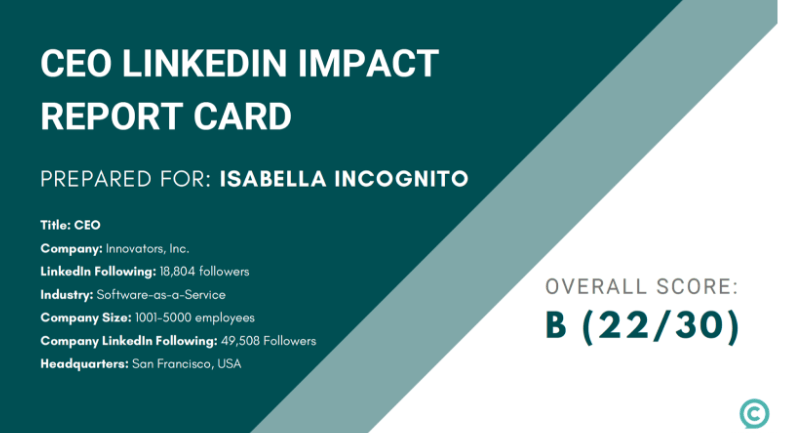
Curious How Your Company's CEO is Doing on LinkedIn?
We specialize in helping executives put their best foot forward. If you're curious how your company's CEO is doing on LinkedIn, share a link to their profile, and we'll prepare a customized CEO LinkedIn Impact Report Card like this.