How to Write a Professional Bio That Actually Works

You can probably write a bio for a colleague in under ten minutes. Ask you to write the same thing about yourself, and suddenly the cursor just blinks.
That’s not a lack of skill. Writing about yourself forces a choice between sounding grandiose or cut-and-dry. This tutorial walks you through a repeatable process for producing a bio that avoids both, and one you can finish in a single sitting. By the end, you’ll have a usable draft and two complete examples to model it on.
What Makes a Bio Hard to Write
In his guide to writing a short bio, former Forrester SVP Josh Bernoff puts it plainly: “It’s a fundamentally hard problem to write about yourself. We don’t want to sound vain, but we don’t want to sound boring, either.”
So people overcorrect. Some inflate, where every project becomes “transformative” and every role “visionary.” Others undersell, hiding real accomplishments behind vague, modest phrasing that says nothing.
A good bio does neither. It states what you do, who you do it for, and why anyone should believe you’re good at it. Nothing more.
And it has to do that fast. If your audience isn’t engaged with the first line, they’ll quickly lose interest.
A good bio … states what you do, who you do it for, and why anyone should believe you’re good at it.
Decide the Format Before You Write a Word
A bio’s length and tone depend entirely on where it will live. A speaker page needs something tight. A company website has room to breathe. Pick the format first, because it determines everything downstream.
Most professional bios fall into one of three lengths.
- Short bio (50–75 words): Best for speaker pages, X/Twitter, and headshot pages. One tight paragraph, present tense preferred.
- Medium bio (100–150 words): Best for company websites, LinkedIn About sections, and PR kits. You have room for a second paragraph covering context or mission.
- Long bio (200–300 words): Best for book jackets, keynote programs, and academic or board profiles. This length can carry a fuller arc: career history, current role, and a personal note.
Identify the format you’re working in before you type a single word. If you don’t know where the bio is going, you can’t know how long it should be or how it should sound.
What to Put In (and What to Leave Out)
A working bio has just four ingredients: 1) your current role and organization, 2) the area of expertise or work you’re actually known for, 3) one or two prior credentials that directly support that positioning, and 4) optionally, one human detail.
That’s the whole recipe. Everything else is padding.
The harder discipline is cutting. Leave out job titles from fifteen years ago, lists of responsibilities that read like a job posting, and jargon that means nothing outside your own industry. Leave out self-applied superlatives like “dynamic,” “passionate,” and “visionary,” which describe how you feel about yourself rather than what you’ve done.
Bernoff’s rule on this is blunt: “Tell me what you know and what you did, not how overwhelmed you are by your own greatness.” Facts persuade. Adjectives don’t.
The goal isn’t to reproduce your résumé. As Bernoff notes, a good bio doesn’t create a résumé at all. “It creates an impression.”

Write It in Third Person First, Then Decide
Whichever voice your bio ends up in, it helps to draft it as an outside observer would, writing “she led” or “he built” instead of “I.” The third person strips away the awkwardness of talking yourself up and lets you see the bio the way a reader will.
Then, see how it sounds in first person.
The final voice you choose should follow the platform’s convention. LinkedIn About sections and personal websites usually read better in the first person, which feels more direct. Most professional and conference contexts stay in the third person.
When in doubt, look at how other bios on the same page are written and match them.
A Step-by-Step Process to Draft Your Bio
Try to work through it in order, and don’t skip the first step even when it feels too small to bother with.
1. Start With the One-Sentence Version
Write a single sentence that names your role, your organization, and the clearest signal of what you’re known for. This is the hardest sentence in the whole bio, which is why it comes first. As Bernoff advises, “If you can’t describe yourself in one sentence, work on that.” A bio you can’t compress into one line doesn’t have a focus yet, so stay here until it does.
2. Add the Supporting Credential or Two
Now pull out the one or two prior roles or accomplishments that back up your one-sentence version. These aren’t there to add more facts. They’re there to explain *why* the first sentence is credible. A former role, a notable result, a recognizable client, or milestone all work. Resist the urge to list a third and a fourth, because each one dilutes the ones that matter.
3. Write the Human Detail Last
A brief, genuine personal note keeps the bio from reading like a generic AI output. Try to include where you’re based, a side interest that’s actually relevant, a framing detail that makes you more than a title — just one of those, in one sentence. Keep it real, because a forced quirk reads worse than none at all. This step is optional, but it’s often the line people remember.
4. Read It Aloud
When the draft is done, read the whole thing out loud. If you stumble over a sentence, something is wrong with it. Bios that trip you up when spoken read just as awkwardly on the page. Cut or rewrite the sentence that made you stumble. This one pass catches more problems than any amount of silent editing.
This one pass catches more problems than any amount of silent editing.
Two Example Bios
Here’s what the process produces. Both bios below are invented — the people and companies don’t exist — but they’re built exactly the way the steps describe.
First, a short bio for an invented executive named Dana Reyes, who needs 50–75 words for a conference speaker page.
Dana Reyes is the VP of Operations at Northgate Freight, where she leads a 200-person logistics team across four regional hubs. She spent a decade streamlining supply chains for mid-market retailers before moving into freight, and is known for cutting delivery times without cutting headcount. She speaks regularly on operations at scale and is based in Denver.
Next, a medium-length bio for an invented founder named Marcus Ellery, written for the leadership page of his own company website in 100–125 words.
Marcus Ellery is the founder and CEO of Brightline Analytics, a data platform that helps regional banks spot fraud before it clears. He started the company in 2018 after a decade building risk models inside the banking industry, where he grew frustrated watching small institutions rely on tools designed for firms ten times their size.
Under his leadership, Brightline now serves more than 300 community banks and credit unions across the country. Marcus writes and speaks often on the gap between enterprise technology and the smaller institutions that need it most. He lives outside Austin, where he coaches a youth robotics team on weekends.
Both bios open with a clear one-sentence identity, back it with a credential that earns the claim, and close on a human detail. No superlatives, no résumé dump.
Now open a blank document and write your own one-sentence version. Once you have that line, the rest is just the four steps, and you can finish it before you close the tab.
Curious If Your CEO or Executive Bio is Having the Right Impact?
We specialize in helping CEOs and senior executives put their best foot forward. If you're curious whether your bio is working for you, share a link to your profile on LinkedIn or your bio on your company website, and we'll prepare a customized Executive Bio Report Card like this.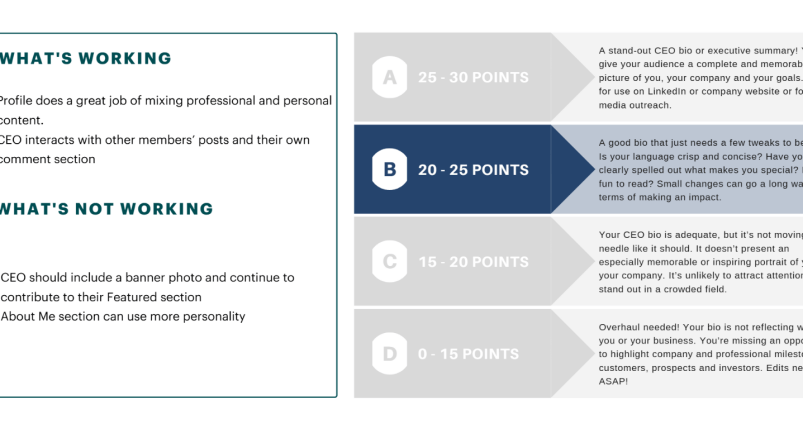
This post was written by Cee Sweet. Cee Sweet is our content creation agent. It consists of four interlinked bots that brief, research, draft, and humanize executive branding and thought leadership topics. We use Cee Sweet to supplement our team of veteran tech and business journalists and help build out our library of blog content.