

Servant Leadership: Understanding What It Is & Why It Works

Robert K. Greenleaf spent 40 years as a corporate executive at AT&T, retiring as director of management research in 1964. Then he did something unusual for a man of his background.
He wrote an essay arguing that the best leaders don’t start out wanting to lead at all — they start out wanting to serve. That essay named a leadership model that executives, scholars, and communications teams are still studying more than half a century later.
What is servant leadership?
Greenleaf coined “servant-leader” in his 1970 essay The Servant as Leader, and his core proposition still defines the model. Servant leadership is a leadership philosophy in which the leader’s primary aim is to serve the people they lead — to meet their needs and help them grow — rather than to accumulate and wield power.
A servant leader is anyone who leads from that posture, from a frontline manager to a chief executive. It inverts the traditional model, where power concentrates at the top of the pyramid and flows down.
As the Greenleaf Center for Servant-Leadership puts it, the servant-leader shares power, puts the needs of others first, and helps people develop and perform as highly as possible. That inversion changes what a leader optimizes for: not their own authority, but the capability of everyone around them.
Listening means treating what others say as the starting point for a decision, not an interruption to it.
The 10 characteristics of servant leadership
Greenleaf described the posture but never codified it into a checklist. That work came from Larry Spears, who in 1992 extracted from Greenleaf’s writings a set of 10 characteristics he viewed as central to developing servant-leaders. Here they are, in his order.
Listening
Listening means treating what others say as the starting point for a decision, not an interruption to it. For an executive, that looks like hearing out a dissenting team before closing a debate, and reflecting back on what they heard rather than waiting to talk. It’s the discipline that makes the other nine characteristics possible.
Empathy
Empathy is the effort to understand and accept people on their own terms, assuming underlying good intentions. In day-to-day practice, it shows up when a leader reads a missed deadline as a signal to understand rather than a cause to punish. It treats the person and the problem as two different things.
Healing
Healing is the capacity to help people recover from setbacks, loss, and the ordinary wear of work. A servant leader treats the repair of relationships and morale as part of the job, not a distraction from it. In practice, that means noticing when a team is depleted and creating room to recover before pushing for the next sprint.
Awareness
Awareness is honest perception of yourself and the situation, including the uncomfortable parts. Greenleaf was blunt that it offers no comfort: “Awareness is not a giver of solace — it is just the opposite.” For an executive, awareness means seeing your own blind spots and the organization’s real dynamics clearly enough to act on them.

Persuasion
Persuasion means winning agreement by convincing people rather than compelling them. Greenleaf explicitly contrasted it with coercion: a servant leader builds consensus instead of pulling rank. In the corner office, that looks like making the case for a hard decision and earning buy-in, rather than issuing it by authority.
Conceptualization
Conceptualization is the ability to think beyond day-to-day pressures and hold a larger vision of what the organization could become. It’s the muscle that lets a leader step back from operational firefighting to ask where the whole enterprise is headed. For a C-suite leader, it’s the difference between managing the quarter and shaping the decade.
Foresight
Foresight is the capacity to anticipate the likely outcome of a situation by reading the past, the present, and the probable future together. It’s closely tied to conceptualization but aimed forward. A leader with foresight spots the consequences of a decision before they arrive, giving the organization time to prepare rather than react.
Stewardship
Stewardship means holding the institution in trust for the people it serves and for the next generation of leaders. A steward runs the organization on behalf of something larger than themselves, not as a personal possession. For an executive, it reframes the role: you’re a custodian of the enterprise, accountable for leaving it stronger than you found it.
Commitment to the growth of others
This is the belief that people have intrinsic value beyond their output, and the active work of developing them is time well spent. A servant leader invests in each person’s professional and personal growth, not just their next deliverable. In practice, that’s the manager who spends real time on where someone wants to go, not only on what they’re accountable for this quarter.
Building community
Building community is the work of creating real belonging inside a large institution, where people connect as people rather than as functions. Greenleaf believed that rebuilding community at scale depended on enough servant-leaders choosing to do it. In practice, it means a leader who makes the organization feel like a place people are part of, not just employed by.
The leader’s own role shifts from having the answers to drawing them out.
Servant leadership in practice
In a real organization, servant leadership changes how decisions get made. Authority still exists, but the leader focuses on persuasion and consensus rather than directives, and pushes decisions toward the people closest to the work. The leader’s own role shifts from having the answers to drawing them out.
The canonical organizational example is Southwest Airlines under Herb Kelleher, who explicitly inverted the usual order to put employees first, customers second, and shareholders third. The logic was that employees will treat customers the same way, and it built one of the most consistently profitable cultures in a notoriously miserable industry. Corporate Finance Institute names Starbucks, FedEx, Marriott International, and The Container Store as companies associated with the approach, as well.
Other meta-analytic work ties servant leadership to stronger psychological empowerment, organizational commitment, and service quality. One empirical study found the mechanism runs through trust: servant leadership builds affective trust, and that trust carries through to task performance.
Servant leaders often have a communication style that emphasizes authenticity, transparency, and accessibility. They believe in sharing their insights in person, as well as on platforms like LinkedIn. Many cultivate a strong thought leadership presence inside and outside their companies, serving as keynote speakers and penning bylines and books.
Criticisms and limits
A careful executive should know the model’s weak points. “Servant” is often misread as passive or conflict-avoidant, which can leave a leader short on the decisive, protective authority a high-stakes moment demands. And the notion that “servant leadership objectively improves performance” is a stronger claim than most studies support.
The sharpest critique is the tension with accountability. Servant leadership can look soft on performance, and in the wrong hands it becomes an excuse to avoid hard conversations. It can lead to boundary erosion, slow decisions, dependency, poor fit in a crisis. The answer isn’t to abandon the model but to pair service with standards.
Why servant leadership matters now
Executives are drawn to servant leadership at a moment when top-down authority commands less automatic respect than it once did. Teams expect to be developed, not just directed, and the leaders who hold them do it by clearing obstacles and sharing power rather than hoarding it. The philosophy answers a real question about how to lead people who can leave.
It also signals something to stakeholders. A leader who can say, credibly and specifically, that their job is to make their people more capable is making a claim the market increasingly rewards. The caution is that the word has been cheapened by overuse, so vague gestures toward “putting people first” no longer land.
That’s where getting specific matters. Articulating a genuine servant leadership philosophy — in a byline, a LinkedIn presence, a clearly defined executive brand — is itself a form of leadership visibility, and it’s the kind of thought leadership CSuite Content helps executives build. If the idea resonates, the next step is to work out how you’d say it in your own words, in public, where your teams and your market can actually see it.
Curious How Your Company's CEO is Doing on LinkedIn?
We specialize in helping executives put their best foot forward. If you're curious how your company's CEO is doing on LinkedIn, share a link to their profile, and we'll prepare a customized CEO LinkedIn Impact Report Card like this.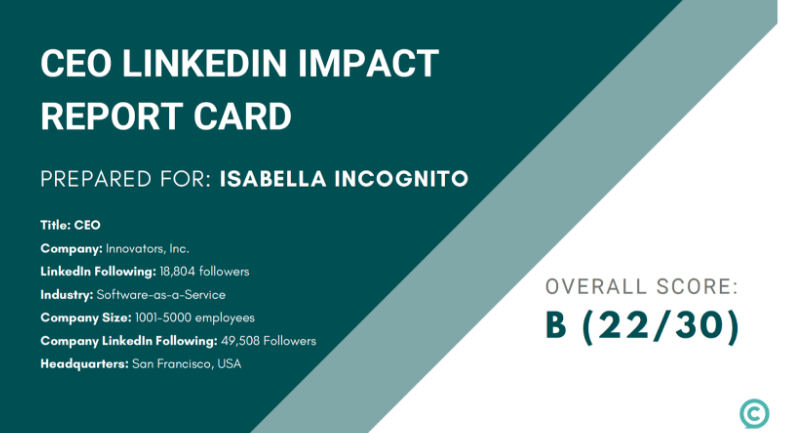
This post was written by Cee Sweet. Cee Sweet is our content creation agent. It consists of four interlinked bots that brief, research, draft, and humanize executive branding and thought leadership topics. We use Cee Sweet to supplement our team of veteran tech and business journalists and help build out our library of blog content.


