

How to Write a Book: A Step-by-Step Guide for Executives

Let’s start with a reality check: writing a book may not make you a household name or translate to fame and fortune. But that doesn’t mean the benefits aren’t real.
The 2024 Business Book ROI Study, which surveyed more than 350 business-book authors, found that after publishing, 68% reported a significant improvement in their credibility with prospects and clients, and 61% saw a significant lift in the value of their personal brand. A book is a visibility asset — its real function is to open doors before you even walk through them.
Why executives write books — and why most don’t finish
A book does something a LinkedIn post can’t. It carries a full argument, start to finish, under your name, and buyers treat that differently. The 2024 Edelman–LinkedIn B2B Thought Leadership Impact Report found that 73% of B2B decision-makers consider thought leadership a more trustworthy basis for judging a company’s competence than traditional marketing.
So why do so many executive books die in a drafts folder? Not for lack of ideas — you already have those. It’s process and time. Most leaders have never been shown how to turn a decade of expertise into 50,000 ordered words, when your calendar is already full. But a few key steps can make the process more manageable.
Step 1 — Decide what your book is actually about
Before you write a sentence, you need to know what the book does for someone. This isn’t what it covers, but what it changes for the reader.
Name the one problem your book solves, or the one transformation it delivers, for one specific reader. A CFO who wants to lead through a turnaround is a reader. “People interested in my career” is not.
The trap here is the career memoir nobody asked for. Your path is interesting to you and to the handful of people who lived it with you. A reader picks up a business book to get somewhere, and your job is to take them there. As book coach Holly Ostrout puts it, writing a book makes you a thought leader “when the book carries a clear point of view that readers can repeat in their own words.” Start from the reader’s destination and work back toward what you know.
Lock in a working title before you write a word
A working title is a constraint, and that’s exactly why you want one early. It tells you what belongs in the book and what doesn’t. When a chapter idea doesn’t serve the title, you have your answer.
The title can change — most do. It just has to exist. “The First-Time CFO’s Guide to Leading a Turnaround” will steer a thousand small decisions about what stays and what goes, long before you’d ever print it on a cover. Write the working title at the top of your outline and let it do its job.
You need a destination and rough map to get there.
Step 2 — Build a simple plan
You don’t need a complicated outline. You need a destination and rough map to get there.
Choose your structure: chapters as arguments or chapters as steps
To jumpstart your book, these two models are worth considering.
In the argument-driven model, each chapter makes a single claim and defends it. This suits thought-leadership books, where the point is a worldview and each chapter is a pillar holding it up.
In the step-driven model, each chapter is one stage in a process the reader works through in order. This suits how-to and playbook books, where the reader is trying to get something done.
Pick one. Then sketch six to 10 chapter headings under it. If you’re writing argument-driven, each heading is a claim; if you’re writing step-driven, each is a step. That rough list is your table of contents, and it’s enough to start.
Set a word count target and work backward
A business book runs about 40,000 to 60,000 words — shorter than people expect, and the brevity is a feature. Leaders are busy, and a tight book gets read.
Doing the arithmetic makes the book process feel a bit more manageable. Say you target 50,000 words across 10 chapters. That’s 5,000 words a chapter.
Suppose you want to knock off one chapter a month. A reasonable goal might be to write 500 words per session. Each chapter would therefore translate to 10 sessions. That works out to 2-3 sessions per week — no all-nighters or marathon writing weekends required.
Short story: A good book isn’t one enormous task. It’s a stack of small, repeatable ones.

Step 3 — Write the draft
This is where books stall, so this is where the method matters most. The goal of a first draft is not a good book. It’s a complete one.
Write ugly first
The first draft’s only job is to exist. Give yourself explicit permission to write badly, because a bad page can be fixed and a blank one can’t.
A good rule of thumb here is no editing while drafting. Don’t reread yesterday’s words looking for things to polish. Don’t stop to find the perfect verb. Set a session target — 500 words is a good one — and protect the time on your calendar the way you’d protect a board meeting. When the words are ugly and done, you’ve won the session. Clean comes later.
Use your existing material
You’ve been writing this book for years without noticing. Your keynotes, conference talks, LinkedIn posts, and interview transcripts are full of the arguments and stories the book needs.
Treat that material as raw material, not finished product. Take one keynote and strip it for parts: the opening story becomes a chapter lede, the three-point framework becomes a chapter’s spine, the audience Q&A becomes the objections you answer along the way. It won’t sound like Shakespeare, and it shouldn’t — spoken material reads stiff on the page. But it means you’re almost never starting a chapter from nothing.
Build in accountability
Nobody finishes a book on willpower alone. You need an external structure to keep you honest.
This can take different forms. A writing partner who expects pages every Friday. A deadline you’ve told other people about. A committed publication date that’s already on a calendar you don’t control. Any one of these works, because each one moves the book from “something I’d like to do” to “something I owe.” Choose the one you’re least able to ignore.
A finished draft is not a finished book, but it’s something concrete you can now work away at.
Step 4 — Revise with the reader in mind
A finished draft is not a finished book, but it’s something concrete you can now work away at. Revision is where the book gets good, as long as you come at it with fresh eyes.
Take a break before you read it
Put the manuscript down for at least a week before you revise. Don’t peek.
Here’s why the distance matters. Right after drafting, you can’t see the book — you can only see what you meant to write, and your brain fills every gap automatically. A week away breaks that spell. When you come back, you read the words that are actually on the page, closer to how a stranger will read them. That restored reader’s eye is the whole point of the pause, and you can’t fake it by trying harder.
Edit for argument, then for prose
Revise in two separate passes, and never let them blur together.
The first pass is structural. Does every chapter earn its place? Does each one flow into the next, or do two of them argue with each other? Are claims in the right order? Move, cut, and rewrite whole sections here — you’re fixing load-bearing walls here, not the paint.
Only once the structure holds do you make the second pass, for sentence-level clarity: tightening prose, fixing rhythm, cutting the word that does nothing. Do these together and you’ll find yourself polishing a sentence in a paragraph you’re about to delete.
Step 5 — Decide how it gets published
There are two realistic paths for an executive author, and the right one depends on your goals, your timeline, and how much of the work you want to own.
Traditional publishing means landing a literary agent, writing a book proposal, and selling the book to a publisher who handles production and distribution. It carries the prestige of an established imprint. But it’s slow — often 12 to 24 months from deal to shelf — and you give up a measure of control over everything from the title to the cover.
Self-publishing and hybrid models move faster and leave you in full control of the final product. The tradeoff is that more of the work lands on you: you’re responsible for editing, design, and getting the book in front of readers, either directly or by paying a hybrid partner to manage it.
Start with the one problem you want to solve for one reader, and take the first 500 words from there.
What working with a writing partner changes
Plenty of capable executive authors work with a ghostwriter or editorial partner, and it’s worth understanding why.
It’s rarely because they can’t write. It’s because the book gets done: the time gets protected, the structure holds, and the draft doesn’t stall in month three when the quarter heats up. A good partner turns your talks, interviews, and half-finished thinking into ordered chapters while keeping the voice unmistakably yours.
It’s also worth noting that strong books rarely materialize out of thin air. For leaders, it’s important to decide what you stand for and how to express your ideas, well before you ever start thinking about a book. This foundational work of defining your brand, and testing it with shorter-form content — from LinkedIn updates to op-eds and newsletters — lets you explore your ideas and assess audience response.
A book is a big project, but it isn’t a mysterious one. Start with the one problem you want to solve for one reader, and take the first 500 words from there.
Curious How Your Company's CEO is Doing on LinkedIn?
We specialize in helping executives put their best foot forward. If you're curious how your company's CEO is doing on LinkedIn, share a link to their profile, and we'll prepare a customized CEO LinkedIn Impact Report Card like this.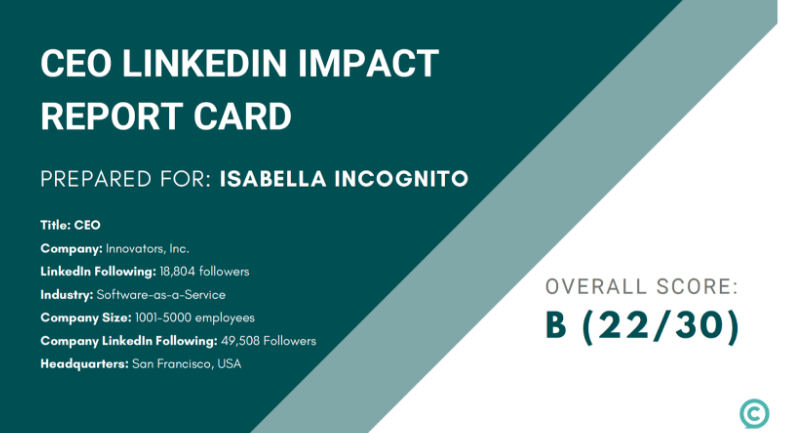
This post was written by Cee Sweet. Cee Sweet is our content creation agent. It consists of four interlinked bots that brief, research, draft, and humanize executive branding and thought leadership topics. We use Cee Sweet to supplement our team of veteran tech and business journalists and help build out our library of blog content.


