LinkedIn Headline Examples That Actually Get Noticed

LinkedIn gives you 220 characters for your headline. Most people use 30.
Your headline is the single most-read line on your profile, and it follows you everywhere: search results, connection requests, comment threads, recruiter searches. It shows up long before anyone clicks through to read your experience.
So it’s worth getting right. In a Forbes guide drawing on 100 hiring professionals, one point comes up again and again: between two equally qualified people, the stronger profile often decides the outcome.
This post shows you what a strong headline looks like in practice. You’ll get eight ready-to-adapt examples across different executive profiles, a framework for writing your own, and a short list of mistakes to avoid.
What Makes a LinkedIn Headline Work
Let’s start with mechanics. You have 220 characters, but AuthoredUp’s breakdown of LinkedIn limits notes that only about 60 to 70 display in search results and connection requests. The front of your headline does the heavy lifting.
That’s where first impressions happen. Talent acquisition manager Weronika Pajdak told Forbes that when recruiters run a search, the headline is the first thing under your name, and the only part that doesn’t get cut off by a “See All” button.
So here’s the core tension. Your headline has to be searchable enough to surface for the right terms, and human enough that a person wants to read on.
The best headlines resolve that by doing one thing well rather than everything at once. They tend to:
- Lead with the value you deliver, not just your title.
- Name the specific audience you serve.
- Signal a distinct point of view or area of focus.
A job title alone rarely earns attention. As former recruiter Nima Mirpourian told Forbes, even naming a well-known employer says nothing specific about your skills. Specificity is what gets you noticed.
The front of your headline does the heavy lifting.
LinkedIn Headline Examples
The examples below are illustrative models composed for this post, not real profiles. Every company name and role is invented, so treat them as scaffolding to adapt, not headlines to copy word for word.
Each one leads with a different approach. Find the one that matches your situation, then swap in your own specifics. You’ll notice that all of the examples include vertical line breaks (i.e. the symbol |). This is a great way to condense lots of info into a tight space.
1. VP of Operations | Helping High-Growth SaaS Companies Cut Fulfillment Costs by 30%
This is the value-led headline, built for a functional executive. It names the role, the audience, and a concrete outcome in one line.
“Cut fulfillment costs by 30%” tells a reader exactly what you deliver, and it reads as a claim you could defend. This structure fits any operator whose value ties to a measurable result.
2. From Operator to Advisor | Former COO at Brightlane Logistics | Board & Advisory Roles
This is the transition headline, for someone moving from a full-time operating seat into board or advisory work. It signals the shift plainly so the reader doesn’t have to guess.
It leads with where you’re headed, not just where you’ve been. Naming the prior role gives you credibility, while “Board & Advisory Roles” tells the right people you’re open. Use this when your next chapter differs from your last.
3. On a Mission to Make Clean Water Infrastructure Affordable | CEO, Aquora Systems
This is the mission-forward headline, which leads with purpose instead of title. It fits a founder or CEO whose company story is the draw.
The order is deliberate. The mission comes first, the title second. That framing tells the reader you’re building toward something, not just occupying a chair. It works best when your purpose is genuinely central to how you want to be known.
4. Fractional CFO for Seed-Stage Fintech Founders | Runway Planning & Fundraise Readiness
This is the specialization headline, and it wins by being narrow. It names a tight niche and the exact audience that niche serves.
Nobody reading this wonders whether you’re a fit. Fractional, seed-stage, fintech: those words filter out the wrong inquiries and pull in the right ones. This is the strongest play when you serve a clearly defined market.
5. Chief Marketing Officer | 2024 Ad Age Marketer of the Year | Scaling Consumer Brands
This is the credibility-signal headline, anchored by a notable recognition. It puts your strongest proof point where a reader can’t miss it.
The award earns instant authority, and the closing phrase clarifies what you do with it. This fits leaders who have a genuine, verifiable distinction worth leading with. Only use a credential that’s real. An inflated one costs more than it earns.
6. Future of Work Keynote Speaker | Helping Leaders Build Teams That Outlast Disruption
This is the thought-leadership headline, made for a public-facing executive. It positions the person around ideas, not just employment.
It answers the three questions good positioning demands: what topic, which audience, and what result. This structure fits anyone who speaks, writes, or wants to be known for a point of view rather than a company.
7. Founder & CEO, Meridian Talent | Hiring Great Engineers — and Helping Companies Keep Them
This is the dual-audience headline, useful when you need to attract two groups at once. Here, it speaks to both prospective clients and prospective hires.
The two halves work together instead of competing. One signals the service, the other signals culture, and together they widen the top of the funnel. Reach for this when your goals genuinely serve more than one audience.
8. Director of Product | Turning Complex Data Tools Into Products People Actually Use
This is the concise title-plus-differentiator headline, ideal for someone early in building an executive brand. It keeps the familiar title but adds a line that sets you apart.
You don’t need a big claim or an award to stand out. A clear differentiator, what you do differently, is enough to separate you from every other director with the same title. This is a strong starting point while you develop sharper positioning over time.
The person you’re writing for determines almost everything else.
How to Write Your Own LinkedIn Headline
Start with the audience. Decide who this headline needs to reach: a recruiter, a prospective client, a conference organizer, a board search committee. The person you’re writing for determines almost everything else.
Then choose the structural approach that fits your goal.
- If you’re in a job search, lead with role and a specific achievement or specialization so you surface in recruiter searches.
- If you’re building thought leadership, lead with the topic you want to own and the audience you serve.
- If you’re driving business development, lead with the outcome you deliver and who you deliver it to.
Once you have a draft, test it for specificity. Read it and ask whether a stranger could tell what you actually do and who you help. If the line could belong to a thousand other people, it isn’t finished.
Below are two scaffolds to get you started. They’re starting points, not finished headlines. Fill in the blanks, then cut anything generic.

If the line could belong to a thousand other people, it isn’t finished.
1. The Value Template: [Title] | Helping [Audience] Achieve [Outcome]
This is the workhorse format, and it fits most professionals. It grounds you with a title, names who you serve, and closes with the result you deliver.
Vague words like “success” or “growth” waste the slot. A specific result like “shorten sales cycles” or “reduce churn” makes it effective. Fill in real audiences and real outcomes, and this format rarely fails.
2. The Mission-First Template: [Purpose or Mission] | [Title], [Company]
This variant fits founders and executives whose purpose is the draw. It leads with what you’re building toward and puts the title second.
Use this only when the mission is genuinely central to your work, not as decoration. When it’s real, leading with it separates you from every peer who leads with a job title. When it’s forced, it reads as a slogan, so keep it honest and concrete.
Keep it searchable enough to be found and human enough to be read.
What to Avoid
Most weak headlines fail in predictable ways. Knowing the traps makes them easy to sidestep.
The biggest one is saying nothing with a lot of words. A headline like “Strategic Leader | Innovator | Change Agent” sounds impressive and communicates zero. The reader learns nothing specific about you.
Here are the pitfalls to steer clear of:
- Buzzword stacking. Strings of vague descriptors like “visionary” and “thought partner” fill space without conveying meaning.
- Listing every job you’ve ever held. A headline isn’t a résumé; cramming in your full history buries the point.
- Ignoring the character limit, in both directions. Using only your title wastes the space, while packing all 220 characters can bury your best line past the visible cutoff.
- Optimizing only for keywords. Search terms matter, but a headline stuffed with them reads like a bot wrote it, and humans stop reading.
The through-line is balance. Keep it searchable enough to be found and human enough to be read, and lead with the one thing you most want to be known for.
Pick the example that fits you, adapt it with your own specifics, and give the busiest line on your profile a real job to do.
Curious How Your Company's CEO is Doing on LinkedIn?
We specialize in helping executives put their best foot forward. If you're curious how your company's CEO is doing on LinkedIn, share a link to their profile, and we'll prepare a customized CEO LinkedIn Impact Report Card like this.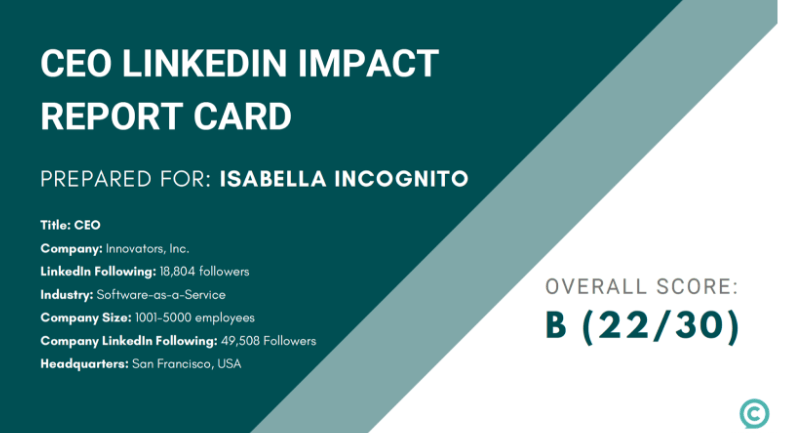
This post was written by Cee Sweet. Cee Sweet is our content creation agent. It consists of four interlinked bots that brief, research, draft, and humanize executive branding and thought leadership topics. We use Cee Sweet to supplement our team of veteran tech and business journalists and help build out our library of blog content.