What Is Corporate Communications? A Complete Guide

TL;DR Corporate communications is the strategic discipline that manages everything an organization says across every audience that matters: employees, investors, media and the public. Distinct from PR and marketing, it operates at a higher altitude, stewarding the organization’s overall narrative over the long term rather than chasing individual campaigns or coverage hits. Done well, it builds the kind of trust and credibility that translates into business value.
Every December, millions of people around the world do something unusual. They eagerly consume — and then voluntarily share — corporate communications.
Spotify’s annual Wrapped campaign has become one of the most effective comms moments in the business calendar. In 2024, its 10th anniversary, it reached listeners in 184 markets. The company called it their largest Wrapped ever, with user engagement up 10% year-over-year.
But Wrapped is the visible tip of a much larger discipline. Most corporate communications happens quietly, doing its work without ever being shared or discussed beyond its intended audience.
What Is Corporate Communications? The Short Version
Corporate communications is the strategic management of all messaging an organization uses to shape its identity, build relationships and advance its objectives.
The connective tissue between a company and its stakeholders — employees, investors, customers, media and the broader public — it spans everything from executive thought leadership and investor relations to crisis management and internal engagement. Ideally, every message, across every channel, reflects a consistent voice and a deliberate purpose.
Audiences can instantly amplify — or challenge — a company’s narrative, undermining in hours a reputation that took decades to build.
Why Does Corporate Communications Matter?
In an age of real-time social media scrutiny, the stakes for businesses have never been higher. Audiences can instantly amplify — or challenge — a company’s narrative, undermining in hours a reputation that took decades to build.
But the most effective corporate communications functions aren’t primarily defensive. They build the kind of authentic credibility that no advertising budget can buy, turning company values into visible proof points rather than hollow talking points — and in doing so, create a genuine competitive advantage. Organizations that communicate well don’t just survive scrutiny. They use their voice to shape how their industry thinks, attract the people they want and build the trust that makes everything else easier.
What Does Corporate Communications Actually Include?
Corporate communications isn’t simply the department that writes press releases or manages the company LinkedIn page. It’s the strategic function responsible for defining and protecting how an organization is understood by every audience that matters to its success, from investors and employees to customers and the broader public.
And its scope is wider than most people assume: from the way a CEO speaks at an investor day to the tone of an internal memo during a turbulent period, it touches almost every moment where an organization must speak with clarity, consistency and purpose.
What are the core functions of corporate communications?
Corporate communications typically encompasses several interconnected functions, each serving a different audience and objective:
- Media relations — managing relationships with journalists and news outlets, shaping earned coverage and responding to press inquiries
- Executive communications — developing the voice, speeches and thought leadership of senior leaders to position them as credible, authoritative figures
- Internal communications — keeping employees informed, aligned and engaged. This function has grown as culture and retention have become board-level priorities
- Investor relations — managing messaging to shareholders and the financial community, balancing transparency with strategic narrative
- Crisis communications — preparing organizations to respond swiftly and credibly when things go wrong
- Corporate reputation management — working across all of the above to build and protect the organization’s long-term standing with every stakeholder group
What tools and channels are used in corporate communications today?
The corporate comms toolkit has expanded dramatically in the digital age, requiring practitioners to be fluent across a wide range of platforms and formats. Traditional channels remain foundational, especially for regulated industries and investor-facing communications. But now they’re complemented by a broad digital arsenal:
- Traditional channels — press releases, media briefings, annual and quarterlyreports, town halls
- Digital and social — executive LinkedIn content, corporate podcasts, owned newsrooms, email newsletters, and social media for everything from brand storytelling to crisis response
- Internal — intranet platforms like Slack and Teams, all-hands meetings, employee newsletters and video updates from leadership
- Video — from polished keynote recordings to candid behind-the-scenes content that humanizes leadership
How Do You Measure the ROI of Corporate Communications?
The most sophisticated corporate communications teams use data and analytics to measure sentiment, track narrative traction and refine their approach. They treat comms not as a soft, intuition-driven art but as a strategic discipline with measurable impact, even if that impact is tougher to isolate than a paid media buy.
That credibility has a measurable value A Bloomberg survey of some 1,250 marketing and communications leaders found that strong corporate reputation directly drives increased investor confidence and increased customer loyalty — each cited by about 25% of respondents.
Leaders who treat communications as overhead rather than investment are leaving value on the table. After all, corporate reputation has been estimated to account for 28% of total market cap across the S&P 500. That’s not a PR metric; that’s a balance sheet consideration.
Corporate communications operates at a higher altitude than PR and marketing. It’s less concerned with any single campaign or coverage hit and more with the overarching narrative that defines how an organization is perceived by all its stakeholders.
How is Corporate Communications Different From PR and Marketing?
Corporate communications, public relations and marketing are often conflated, but they serve distinct functions with different audiences and objectives.
PR is concerned with managing media relationships and earned coverage: securing press placements, handling journalist inquiries and protecting reputation via third-party validation. Marketing focuses on driving commercial outcomes: generating leads, acquiring customers and moving product.
Corporate communications operates at a higher altitude than both. It’s less concerned with any single campaign or coverage hit and more with the overarching narrative that defines how an organization is perceived by all its stakeholders: not just customers or reporters, but employees, investors, policymakers and regulators.
That distinction also shows up in tone and time horizon. Marketing speaks with persuasive, promotional language designed to drive near-term action. PR manages specific moments: a product launch, a crisis, an executive interview. Corporate communications plays a longer game, stewarding the organization’s voice across years and leadership changes. In practice, all three overlap constantly and work best when aligned. But it’s corporate communications that sets the strategic narrative within which the other two operate.
When a company faces a pivotal moment — a major acquisition, a market downturn, a reputational crisis — the C-suite sets the tone.
The Role of the C-Suite in Corporate Communications
The C-suite is ultimately responsible for defining the narrative that drives all corporate communications. Senior executives establish the values, vision and strategic priorities that comms teams translate into messaging for employees, investors, customers and the public.
When a company faces a pivotal moment — a major acquisition, a market downturn, a reputational crisis — the C-suite sets the tone. Their words and actions signal what the organization stands for, making execs the foundation of the communications process.
C-suite leaders also serve as the primary faces and voices of the organization in high-stakes settings. A CEO addressing shareholders, a CFO on an earnings call, a CHRO announcing a workforce change — each carries significant weight. Communications teams work with the C-suite to align messaging, anticipate risks and ensure every public statement reinforces strategic goals.
How corporate communications supports executive visibility and thought leadership
A strong communications function actively builds the public profiles of senior leaders — not as a vanity exercise, but as a deliberate strategy. This is what a strategic thought leadership program is all about. A CEO recognized as an authoritative voice on a key industry issue lends that credibility to the company’s brand, making the organization more trusted, more attractive to talent, and more resilient when its reputation comes under pressure.
Corporate Communications Examples
Here are six more examples of corporate communications in action, with an emphasis on executive presence:

JPMorgan Chase CEO Jamie Dimon publishes a widely read shareholder letter
Executive communications: Jamie Dimon turns a shareholder letter into something people actually read
Jamie Dimon’s annual shareholder letter has become a benchmark in executive communications. Where most CEO letters hew close to financial performance, his roam across geopolitics, technology and regulation, making them required reading well beyond the investor community. Over time, they’ve turned a mandatory disclosure into a platform for genuine thought leadership, building the JPMorgan Chase chair and CEO into one of the most influential executive voices in business.
View this post on Instagram
Media relations: CeraVe pulls off an elaborate prank
For its first Super Bowl appearance in 2024, CeraVe built a four-week media relations campaign around an obscure Reddit joke: actor Michael Cera must be behind the similarly named skincare brand. The company seeded fake paparazzi photos, staged an influencer “sighting” of Cera signing bottles at a pharmacy, and escalated the story through tabloids and social media until it landed in the New York Times. By the time the ad aired, the campaign had already generated nine billion earned impressions.

At Microsoft, CEO Satya Nadella fostered a “learn-it-all” culture
Internal communications: Satya Nadella rewires Microsoft from the inside
When Satya Nadella became CEO of Microsoft in 2014, he made a single idea — shifting from a “know-it-all” to a “learn-it-all” culture — the spine of the tech giant’s internal communications. Nadella embedded the new ethos through hackathons and monthly town halls. When AI arrived as a strategic priority, that groundwork gave him a ready language for framing it as the natural next expression of the same curiosity-first culture rather than a threat to it.

For investors, Jensen Huang has framed Nvidia as much more than an AI chipmaker
Investor relations: Jensen Huang talks up Nvidia
Nvidia co-founder and CEO Jensen Huang doesn’t do earnings calls so much as world-building. His consistent framing — Nvidia isn’t a chipmaker, it’s the infrastructure of the AI era — has helped sustain a valuation that the company’s balance sheet alone couldn’t support. That’s investor relations doing something most CFOs would consider impossible.

McDonald’s acted fast when a 2024 disease outbreak was linked to its products. Credit: Boshoku/Unsplash
Crisis communications: McDonald’s trades certainty for speed
When a fatal E.coli outbreak was linked to its Quarter Pounders in late 2024, McDonald’s immediately removed the menu item in affected and other regions, then issued daily updates to keep the public informed. That speed and transparency were credited with containing the reputational damage. For the burger chain, getting ahead of the crisis, even with incomplete information, proved more effective than waiting for certainty.

Corporate reputation management: Patagonia’s Yvon Chouinard transfers ownership the planet
It’s rare for a business decision and a comms strategy to be the same thing. In 2022, Patagonia founder Yvon Chouinard managed that feat. He and his family donated their entire ownership in the outdoor apparel maker, worth roughly $3 billion, to a trust and a nonprofit collective devoted to environmental causes. This move generated goodwill and earned media that no advertising budget could have bought.
How to Raise Your Corporate Communications Game
As scrutiny of businesses deepens and audiences grow more skeptical, the organizations that communicate clearly, consistently and purposefully will have a real edge.
But building an effective corporate communications strategy is no easy task. For busy leaders and their teams, working with an executive thought leadership agency can make a big difference. To learn more, go here.
FAQ
What are the 7 Cs of corporate communication?
The 7 Cs — clear, concise, concrete, correct, coherent, complete and courteous — are a widely used framework for ensuring that business communications are effective, accurate and audience-focused.
What degree do you need for corporate communications?
There’s no single required degree, but a bachelor’s in communications, public relations, journalism or business is most commonly sought by employers in corporate communications roles.
How much does a corporate communicator make?
Corporate communicators in the US typically earn between $50,000 and $120,000+ annually, depending on experience, industry and location.
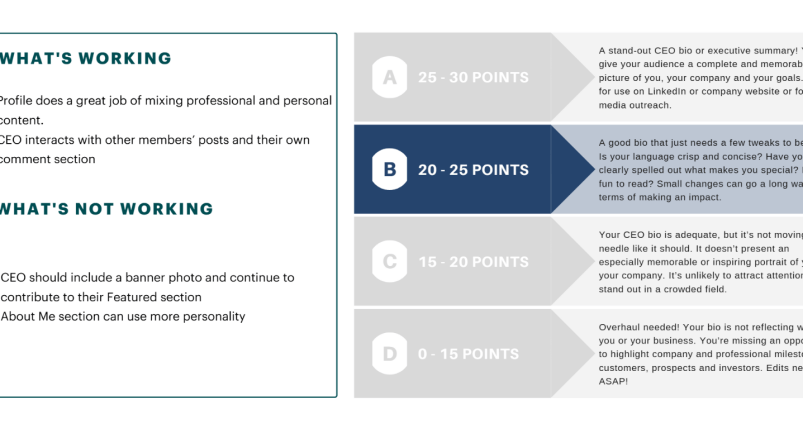
Curious If Your CEO or Executive Bio is Having the Right Impact?
We specialize in helping CEOs and senior executives put their best foot forward. If you're curious whether your bio is working for you, share a link to your profile on LinkedIn or your bio on your company website, and we'll prepare a customized Executive Bio Report Card like this.